 Observatorio de la Administración Pública · UNAL
 Territorial indicators with official source traceability (SIGEP, DAFP, DANE). Data comes from the national open data platform (datos.gov.co) and is processed with R.
Civil Service and Public Employment
DI-1 · SC-EPSociodemographic characterization of public servants in the Executive Branch (national and territorial levels) registered in SIGEP II.
SIGEP II · Updated: March 2025 · 4,150 records × 44 variables · Open license
Civil Service Charts
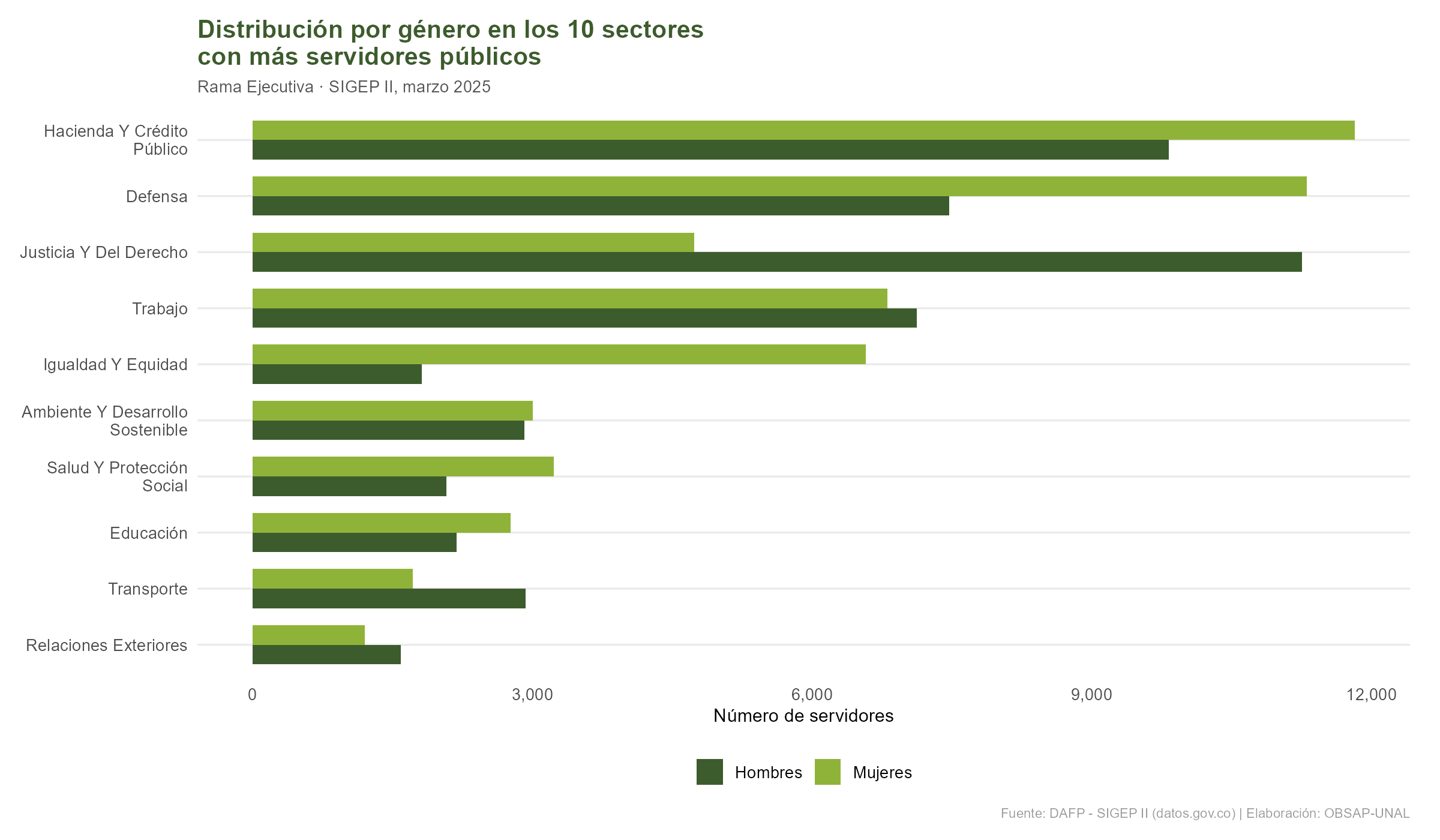
Gender distribution in the 10 sectors with most public servants
Executive Branch · SIGEP II, March 2025
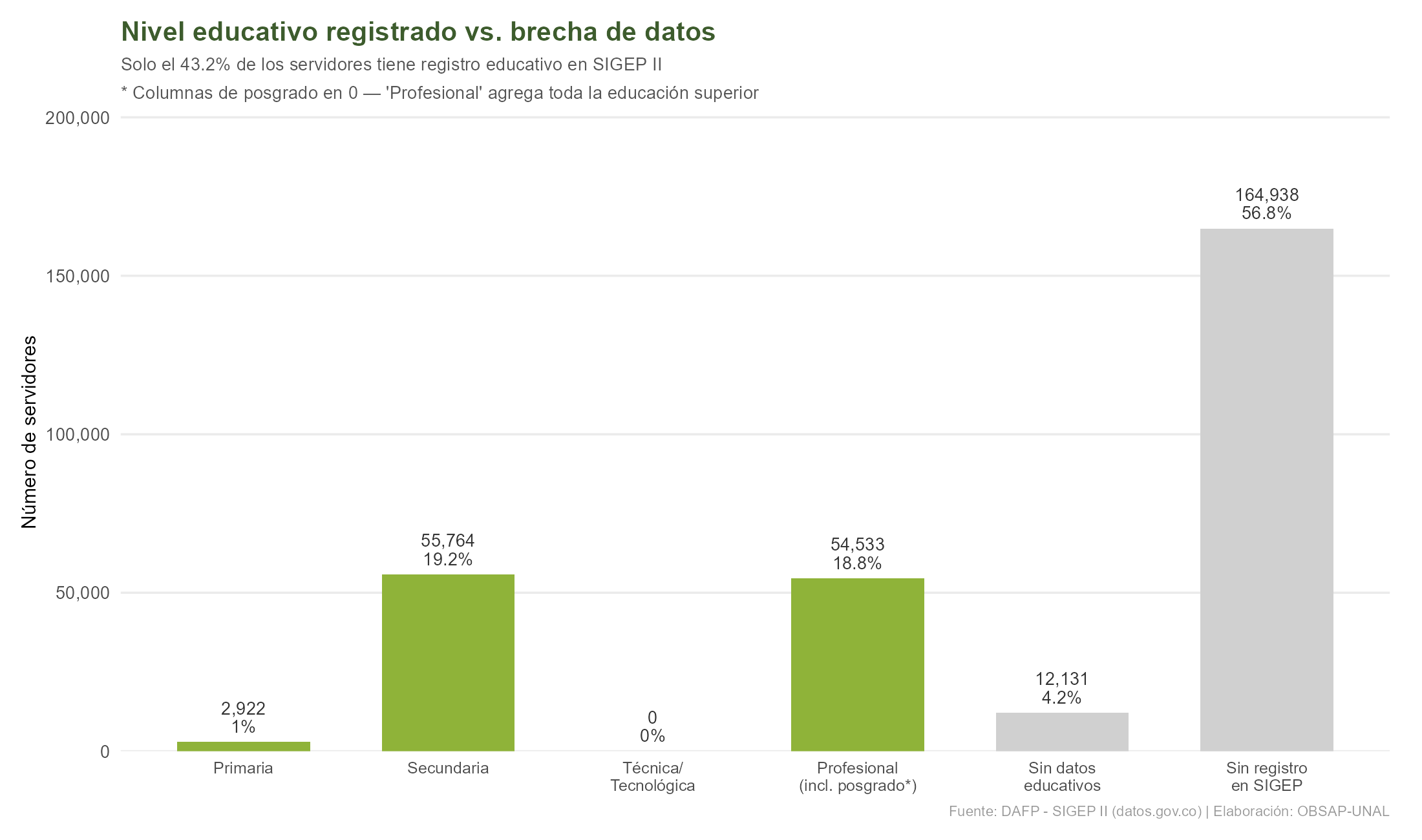
Educational level of public servants
National distribution · SIGEP II
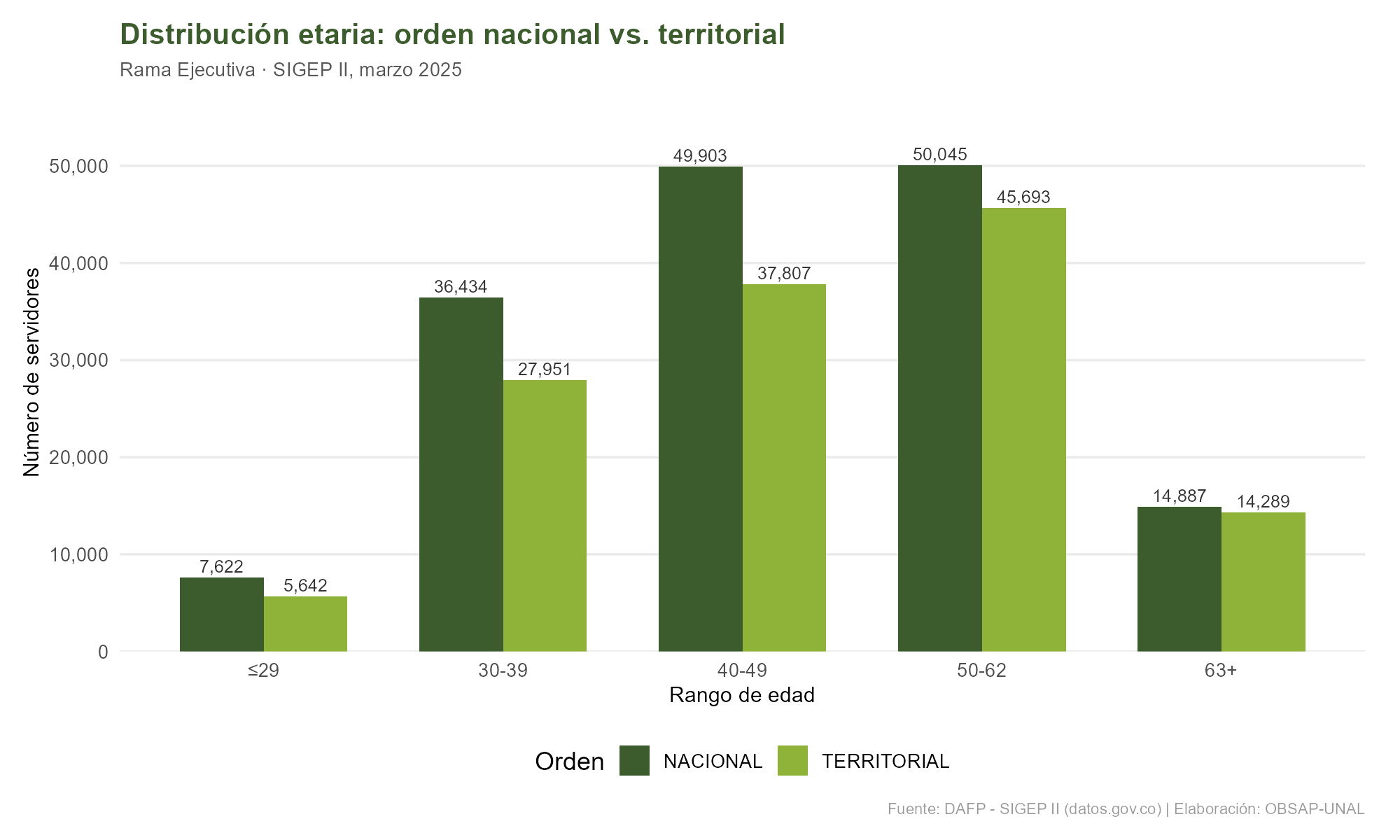
Age distribution: national vs. territorial
Age ranges by level of government
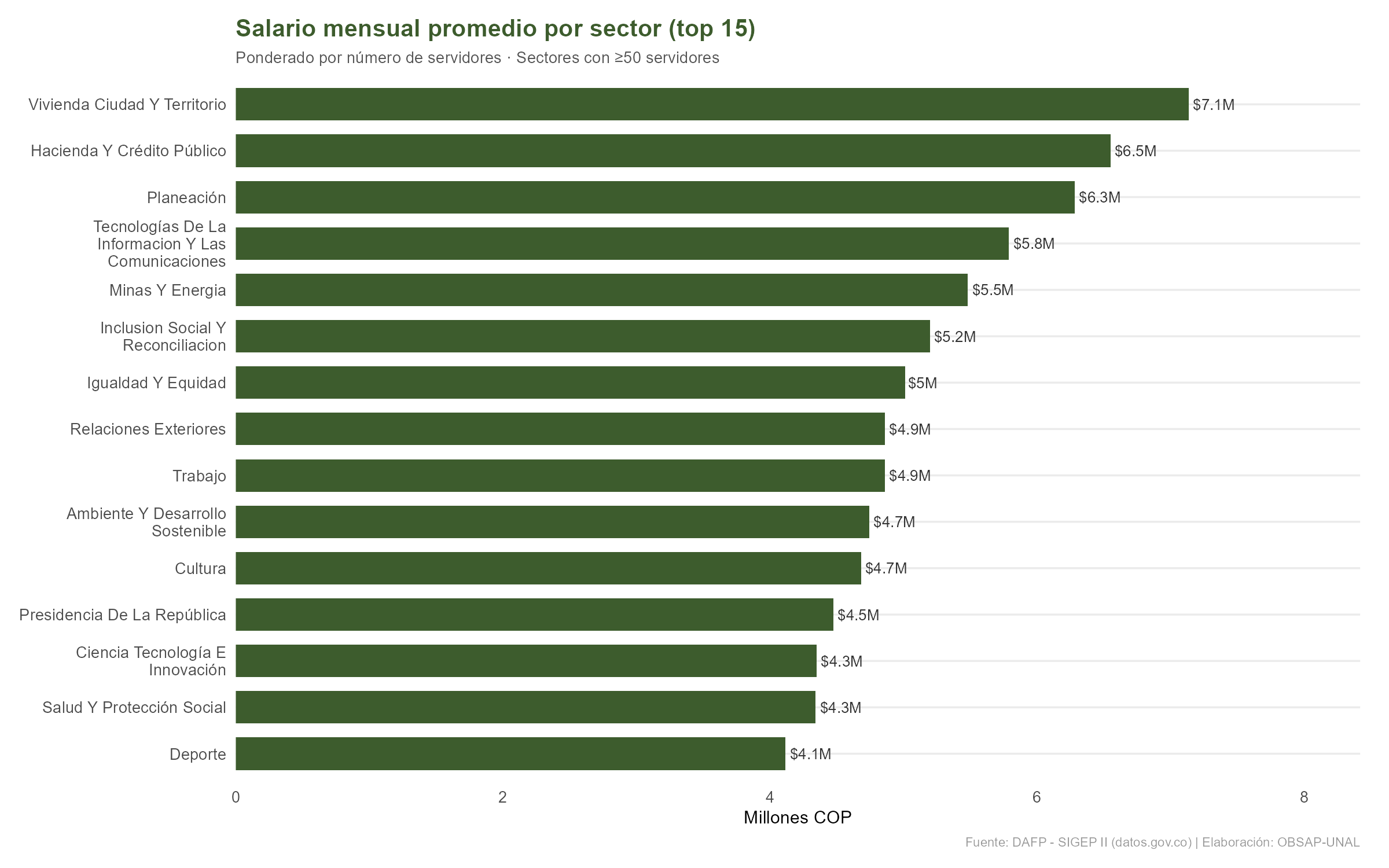
Average monthly salary by sector (top 15)
Weighted by number of servants · Sectors with ≥50 servants
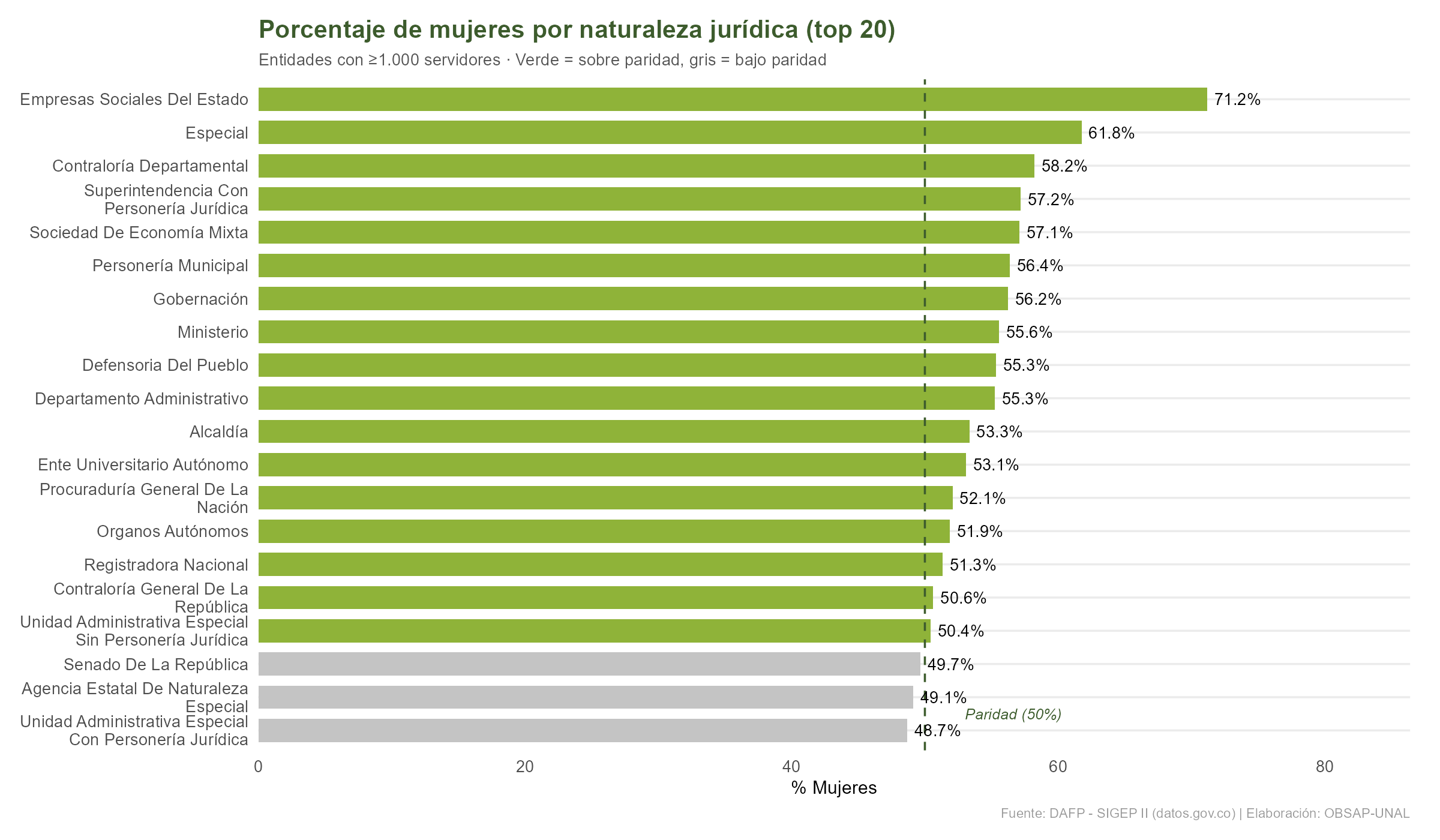
Percentage of women by legal nature (top 20)
Green = above parity, gray = below parity · Entities with ≥1,000 servants
Methodological note
Charts were generated with R (tidyverse + ggplot2) from the Public Employment Characterization dataset published by DAFP on the national open data platform. The dataset contains 4,150 records corresponding to Executive Branch entities (national and territorial levels), with 44 variables including gender, education level, age, work experience, and average salary per entity. Data corresponds to the March 2025 SIGEP II snapshot.
Data quality finding
Only 43.2% of public servants (125,350 of 290,288) have educational records in the SIGEP II open data extraction. Additionally, postgraduate education columns (specialization, master's, doctorate) show zero values across all 4,150 records, despite existing in the dataset schema. The "Professional" field likely aggregates all higher education (undergraduate and postgraduate) without distinguishing levels, which constitutes a relevant limitation for human capital analysis in the Colombian civil service.
Data backup
OBSAP maintains a local copy of the dataset in CSV format as a backup against potential changes or unavailability of the datos.gov.co API. Data is periodically downloaded via the national portal's Socrata API (SODA) and versioned alongside the observatory source code. The OBSAP open data repository is available on Open Science Framework (OSF).
International Context
Colombia in comparative perspective: public employment indicators compared to Latin America and the OECD. Data consolidated from the four editions of Government at a Glance: Latin America and the Caribbean (OECD/IDB, 2014–2024).
Comparative analysis
The longitudinal series of four editions (2014–2024) confirms that Colombia is persistently the country with the lowest proportion of public employment both in LAC and the entire OECD: 3.7% in 2010, 4.0% in 2014, 3.7% in 2018, and 4% in 2022 — fluctuating between 3.7% and 4% for over a decade, while the LAC average remained stable at ~12% and the OECD grew from 15% to 21%. However, in gender parity, Colombia advanced from 47.3% (2021) to 52.1% of women in civil service (2025), placing itself above the LAC average (51.5%) and aligning with the regional trend of female majority in the public sector.
Culture and Administrative Behavior
DI-2 · C-CAOCA instrument results, administrative culture data, organizational behavior, and behavioral sciences applied to public management.
Dashboard under construction
Indicators for this dimension will be available once the OCA instrument database and R engine are connected.
Structure and Organizational Design
DI-3 · E-DOMapping organizational reforms, comparative org charts, institutional capacities, and public entity transformations.
Dashboard under construction
Indicators for this dimension will be available once the database and R analysis engine for organizational reforms are connected.
Principles, Administrative Fads, and Public Innovation
ETI · PMA-IPCross-cutting tracking of paradigms, administrative fads, open government, public innovation, and artificial intelligence in public management.
Dashboard under construction
Indicators for this cross-cutting axis will be available once the database and R engine are connected.